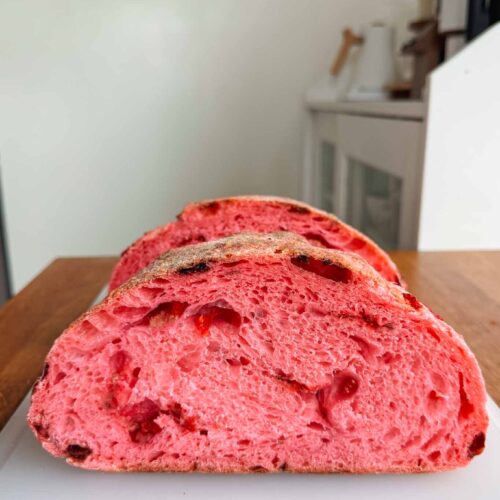
Strawberry Sourdough Bread
This fresh strawberry sourdough bread is naturally sweet, with delicious swirls of real strawberry in every single bite. Filled with fresh, diced strawberries and freeze-dried strawberries, it’s so easy to make and bursting with strawberry flavor.
Ingredients
- Sourdough Starter
- 20 g (1 tablespoon) active sourdough starter
- 80 g (⅔ cups) flour
- 80 g (⅓ cups) water
Bread Dough
- 475 g (3 ¾ cups) bread flour
- 25 g (3 tablespoons) whole wheat flour
- 360 grams (1 ½ cups) water
- 100 g ½ cup sourdough starter
- 10 g (1 ½ teaspoons) salt
- 30 g (2 tablespoons) sugar
- 120 g ( ¾ cup) fresh strawberries diced
- 30 g (1 ½ oz) freeze dried strawberries a mix of crushed and whole pieces.
- Optional: Pink food coloring to make the dough fully pink
Instructions
Sourdough Starter
- Prepare your sourdough starter: The night before or approximately 8 - 12 hours before you plan on mixing the dough, prepare your sourdough starter. You’ll need 100g of ripe, active starter for this recipe so I recommend reserving 20g (1 tablespoon) of starter and feeding it 80g (⅔ cups) flour and 80g (⅓ cup) water. Your starter is ready to use when it’s doubled in size, bubbly, and has just begun to fall back down from it’s peak height.20 g (1 tablespoon) active sourdough starter, 80 g (⅔ cups) flour, 80 g (⅓ cups) water
Day 1: Make the Dough and First Rise
- Make the dough: In a large mixing bowl, add the water, sourdough starter, and sugar and whisk together until combined. Pour in the flour, salt, and optional food coloring and mix together until a dough forms and no dry patches remain. Cover the bowl and let the dough rest for 30 minutes.475 g (3 ¾ cups) bread flour, 25 g (3 tablespoons) whole wheat flour, 360 grams (1 ½ cups) water, 100 g ½ cup sourdough starter, 10 g (1 ½ teaspoons) salt , 30 g (2 tablespoons) sugar, Optional: Pink food coloring to make the dough fully pink
- Stretch and fold: After 30 minutes have passed, perform one set of stretch and folds. Stretch and folds help to build gluten in the dough, giving it better height, structure, and texture when baked. To perform one set of stretch and folds, begin by adding some water to your hands – this helps prevent sticking. Grab one side of the dough and stretch it up and over towards the middle. Rotate the dough and repeat this with the other side. Repeat with two more times until all 4 sides have been stretch and folded. Let the dough rest for 30 minutes before performing your next round of stretch and folds. During the course of the bulk fermentation in the next step, perform three more complete rounds of stretch and folds, each spaced out by 60 minutes, until you’ve performed a total of 4 sets of stretch and folds.
- First rise: Allow the dough to rise at room temperature for about 4 to 6 hours. The bulk fermentation is complete when the dough has grown by roughly 50% in volume, has air bubbles on top, and is jiggly when shaken. Depending on how active your starter is and the warmth of your kitchen, the rise may take closer to 8–10 hours. Be patient and look use the visual cues to determine when your bread is done rising!
- Add the strawberries (lamination): Once the dough is done rising, it’s time to add the strawberries! Lightly mist your work surface with water and turn the dough out onto it. With damp hands, gently stretch the dough into a thin, rectangular sheet about ¼” thick, being careful not to tear it. Add the freeze dried strawberries and evenly scatter them across the dough. I like to add whole pieces and then crumble some of them over the dough so there is a mix of pieces and powder. Next, add the diced strawberries make sure they’re evenly distributed across the surface. Fold one side of the dough toward the center, then fold the opposite side over it to form a long rectangle. Starting at the short end, roll the dough up into a loose log and place it back into the bowl. Cover and let it rest for another 60 minutes. With lightly floured hands, shape the dough into a smooth, round ball by gently dragging it across the work surface to create tension on the surface. Use a dough scraper to carefully lift the dough and transfer it to a lightly floured, lined proofing basket, placing it seam-side up.30 g (1 ½ oz) freeze dried strawberries, 120 g ( ¾ cup) fresh strawberries
- Proof the dough (second rise): Cover the dough and refrigerate it overnight, or up to 48 hours. I recommend proofing for at least 12 hours because the long cold proof helps develop flavor and improve the texture and structure of the baked bread. The extended fermentation time gives time for the beneficial bacteria in your sourdough starter to work their magic and unlock the gut healthy benefits of sourdough!
Day 2: Shape, Score, and Bake the Bread!
- Preheat the oven and Dutch oven: When you’re ready to bake, place your Dutch oven (with the lid on) inside your oven and preheat it to 500°F for 30 minutes to 1 hour. Make sure it’s thoroughly heated before baking — a hot Dutch oven is key for achieving great oven spring and a beautiful crust.
- Score the bread: When your Dutch oven is fully preheated, take the dough out of the fridge. Lay a sheet of parchment paper over the top of the dough and the proofing basket, then gently turn the dough out onto your work surface so it’s on top of the parchment. Using a bread lame or sharp knife, make at cut in the dough at a 45° angle—just deep enough to cut through the outer skin. I usually make one clean, long slash across the surface, but you can also make a plus sign, “+” but making 2 straight cuts.
- Bake: Carefully remove your preheated Dutch oven from the oven and take off the lid. Lift the dough by the edges of the parchment paper and gently lower it into the pot. Cover with the lid and bake at 500°F for 30 minutes. Then remove the lid and continue baking for another 10–15 minutes, until the crust is deep golden brown or the internal temperature reaches 208–210°F. Transfer the loaf to a cooling rack and let it cool completely for 1–2 hours before slicing.
- Enjoy! Slice into your beautiful strawberry sourdough bread and serve it with any of your favorite toppings. I love mine with a thick spread of homemade whipped vanilla honey butter!